

Plantar Fascia Strain Symptoms: 7 Signs That Actually Matter
That sharp, knife-like pain shooting through your heel the moment your foot hits the floor — it's one of the most recognizable complaints in sports medicine and podiatric practice. Yet it remains widely misunderstood and, critically, undertreated in its early stages. Plantar fascia strain symptoms affect an estimated 2 million Americans every year, and roughly 1 in 10 people will experience them at some point in their life, according to data from the American Academy of Orthopaedic Surgeons. Despite how common the condition is, most people wait weeks — sometimes months — before taking action, allowing a manageable strain to become a chronic, debilitating injury.
The plantar fascia is a dense band of connective tissue running from your heel bone to the base of your toes. Its job is mechanical: it absorbs shock, maintains your foot's arch, and propels your body forward with every step. When overstressed — through repetitive impact, poor footwear, or biomechanical imbalance — it develops micro-tears, triggering inflammation and pain. This guide breaks down the symptoms by clinical severity, shows you how to distinguish them from similar conditions, and outlines the fastest evidence-based path to relief.
What Is Plantar Fascia Strain — And Is It the Same as Plantar Fasciitis?

The terms are often used interchangeably, but they describe two distinct clinical presentations that sit on the same injury spectrum.
A plantar fascia strain refers to an acute or sub-acute overload of the fascia — micro-tears triggered by a sudden increase in activity, a change in training surface, or a single high-impact event. The damage is real and immediate. Plantar fasciitis, on the other hand, describes the chronic inflammatory response that develops when repeated strain goes unaddressed over weeks or months. The "-itis" suffix signals established inflammation, not just mechanical overload.
In practice, the symptoms overlap significantly. Both conditions produce heel pain, arch tightness, and morning stiffness. The key clinical difference lies in onset and pattern: a strain tends to appear suddenly after a specific event or spike in activity, while fasciitis builds gradually with no clear triggering moment.
For the purposes of this guide — and for your recovery — the distinction matters less than the shared underlying mechanism: excessive tensile load on a tissue that has exceeded its tolerance threshold.
The 7 Key Symptoms of Plantar Fascia Strain
Not all symptoms carry equal diagnostic weight. Understanding which signs are primary — almost universally present — and which are secondary helps you assess severity accurately and act accordingly.
1. Stabbing heel pain with your first morning steps
This is the hallmark sign. During sleep, the plantar fascia shortens into a contracted position. The moment you stand and load your foot, the sudden stretch pulls on already irritated tissue — producing that characteristic sharp, knife-like pain at the base of the heel. It typically eases after five to ten minutes of walking as the fascia warms up and lengthens. If the pain does not subside within that window, the strain is likely more advanced.
2. Pain that returns after sitting or resting
Known clinically as "start-up pain," this symptom follows the same mechanism as morning pain but occurs throughout the day — after a long meeting, a car journey, or any extended period of inactivity. It is one of the most reliable differentiators between plantar fascia strain symptoms and a stress fracture, which tends to produce continuous, activity-dependent pain rather than this rest-then-load pattern.
3. Localized tenderness at the heel bone attachment
Press firmly with your thumb approximately 2–3 cm forward from the center of your heel, along the inner edge of the foot. Sharp, reproducible pain at that precise point — where the fascia inserts into the calcaneus — is a strong clinical indicator of fascial involvement. Tenderness that is diffuse or located at the back of the heel points more toward Achilles tendinopathy.
4. Arch pain or tightness after prolonged standing

The plantar fascia supports the medial longitudinal arch with every step. When strained, sustained loading — a full shift on your feet, a long supermarket run — causes a progressive, aching tightness along the arch. This symptom is particularly pronounced in people with flat feet or high arches, both of which create abnormal force distribution across the fascia.
5. Worsening pain on hard surfaces or barefoot
Concrete, tile, and hardwood floors offer zero shock absorption. Walking barefoot or in flat, unsupportive shoes on these surfaces significantly amplifies the mechanical load transmitted through the fascia. If you notice your pain reliably worsens on hard floors and improves in cushioned, arch-supportive footwear, the plantar fascia is almost certainly the source.
6. Stiffness in the ankle or calf
The plantar fascia does not function in isolation. It forms part of a continuous biomechanical chain with the Achilles tendon and the calf muscle complex. Tightness in the gastrocnemius or soleus increases the tensile pull on the fascia from above, amplifying strain at the heel. Morning calf stiffness alongside heel pain is a common combined presentation that signals this kinetic chain involvement.
7. Numbness, tingling, or burning sensation
If your heel or arch pain is accompanied by numbness, a burning feeling, or pins and needles radiating into the toes, this is no longer a straightforward fascial strain. These neurological symptoms suggest possible tarsal tunnel syndrome — compression of the posterior tibial nerve — or another pathology requiring clinical investigation. Do not self-treat this presentation. See a podiatrist or orthopedic specialist promptly.
Who Gets Plantar Fascia Strain? The 5 Real Risk Factors

Plantar fascia strain does not develop randomly. In clinical practice, the vast majority of cases share a recognizable profile. Identifying your risk factors is not just academic — it directly informs which interventions will be most effective for your specific situation.
1. Runners and high-impact athletes
Distance runners are disproportionately affected, with incidence rates reaching 10% annually among regular training populations. The repetitive heel-strike pattern, combined with cumulative weekly mileage, places the fascia under thousands of loading cycles per session. Sudden spikes in training volume — the classic "too much, too fast" error — are the most common triggering event.
2. Professionals who stand for extended periods
Nurses, teachers, retail workers, and warehouse employees spend six to eight hours per day on hard surfaces with minimal opportunity to offload the foot. The fascia never fully recovers between loading cycles, and cumulative micro-damage accumulates faster than the tissue can repair itself.
3. Individuals with a BMI above 30
Excess body weight directly amplifies the compressive and tensile forces transmitted through the plantar fascia with every step. Research consistently identifies obesity as one of the strongest independent risk factors for developing chronic plantar fascia strain symptoms, particularly in non-athletic populations.
4. Flat feet or high arch foot structure
Both extremes of arch morphology create abnormal load distribution across the fascia. Flat feet (overpronation) stretch the fascia lengthwise with every step. High arches reduce the foot's natural shock absorption, concentrating impact forces at the heel insertion. Neither is inherently pathological — but both significantly increase fascial vulnerability without appropriate footwear correction.
5. Worn-out or unsupportive footwear
Shoes without adequate arch support or heel cushioning are a major modifiable risk factor. Flip-flops, flat canvas sneakers, and shoes with more than 500 miles of wear offer virtually no fascial protection. The mechanical consequences are immediate and cumulative: every step in unsupportive footwear is a missed opportunity for load redistribution.
What Should You Do If You Recognize These Symptoms?
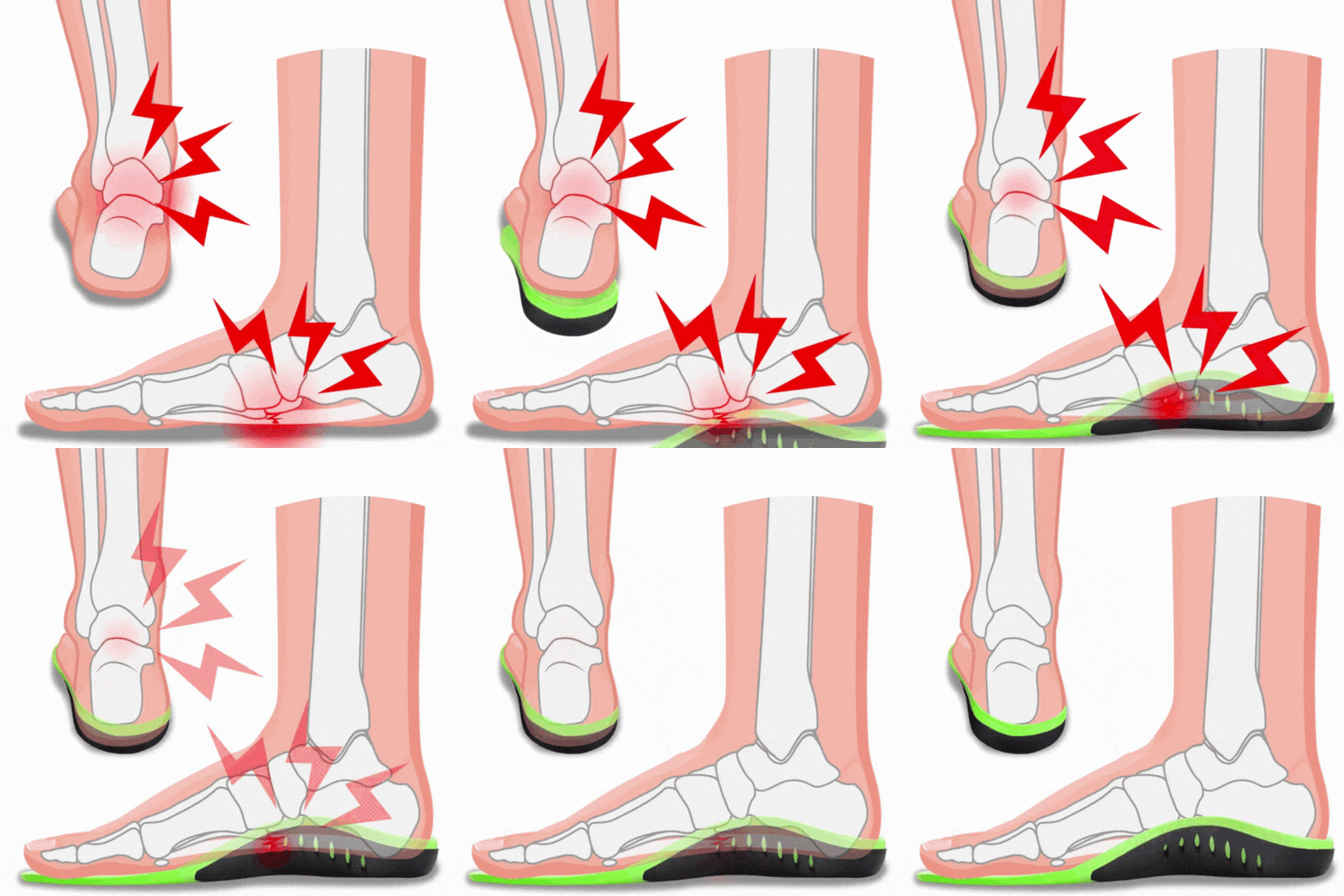
Recognizing plantar fascia strain symptoms early is your single biggest advantage. The tissue responds well to conservative management when intervention begins promptly — but becomes significantly harder to treat once chronic inflammation sets in. Here is a tiered response protocol based on symptom duration and severity.
If symptoms are mild and recent (under 1 week)
Start immediately with the RICE protocol and these targeted actions:
- Rest from all high-impact activity (running, jumping, prolonged standing)
- Ice the heel for 10–15 minutes, twice daily, wrapped in a thin cloth
- Stretch the plantar fascia and calf before your first step of the day
- Switch footwear immediately — no barefoot walking on hard floors, no flip-flops
The most effective morning stretch: before your first step, sit at the edge of the bed and pull your toes back toward your shin for 30 seconds, three repetitions. This pre-loads the fascia gently before full weight-bearing and measurably reduces start-up pain.
Footwear intervention at this stage is non-negotiable. Adding a dedicated orthopedic insole accelerates recovery by redistributing load away from the inflamed insertion point. Semello's Plantar Fasciitis Insole – Daily Comfort combines targeted arch support with heel cushioning to reduce fascial tension throughout the day. For heel-specific pain, the Gel Heel Pad provides localized shock absorption directly at the calcaneal insertion. If footwear itself is part of the problem, Semello's orthopedic shoe collection offers medically-informed designs that support the foot's natural biomechanics from the ground up.
If symptoms persist between 1 and 4 weeks
Self-management alone is no longer sufficient. At this stage, take the following steps:
- Consult a podiatrist or sports medicine physician for clinical confirmation of the diagnosis
- Rule out differential conditions — stress fracture, tarsal tunnel syndrome, heel spur
- Consider physical therapy focused on eccentric calf strengthening and fascial mobilization
- Continue all conservative measures — insoles, supportive footwear, stretching protocol
- Avoid returning to high-impact activity until morning pain has resolved for five consecutive days
If red flag symptoms are present or no improvement after 6 weeks
This presentation requires specialist-led investigation. Key steps:
- Request imaging: ultrasound to confirm fascial thickening and micro-tears; MRI if partial or complete rupture is suspected
- Do not continue self-treating; chronic plantar fasciitis responds poorly to rest alone at this stage
- Discuss advanced options with your specialist: corticosteroid injection, platelet-rich plasma (PRP), or extracorporeal shockwave therapy (ESWT)

Don't Let Heel Pain Become a Chronic Problem
Plantar fascia strain follows a predictable pattern: mild discomfort ignored becomes persistent pain, persistent pain becomes chronic inflammation, and chronic inflammation becomes a months-long recovery instead of a weeks-long one. The window for easy intervention is early — and it is shorter than most people assume.
If you recognize three or more of the symptoms described in this guide, your plantar fascia is already under significant stress. The fastest path to recovery is not waiting to see if it resolves on its own. It is reducing the mechanical load on the fascia immediately — through targeted stretching, appropriate footwear, and quality arch support — while your tissue still has the capacity to heal efficiently. Your feet carry your entire body weight, thousands of times a day. They deserve the right foundation.
Explore Semello's Plantar Fasciitis Insoles and Orthopedic Shoes — designed to support recovery from the ground up.
Frequently Asked Questions
Can you walk with plantar fascia strain?
Yes — but with important caveats. Walking is generally tolerable and even beneficial in mild cases, as gentle movement promotes circulation and fascial flexibility. However, walking barefoot on hard surfaces, for extended distances, or in unsupportive footwear will aggravate the condition. The rule of thumb: if your pain level exceeds 3 out of 10 during walking, reduce distance and prioritize footwear support before continuing.
How long does plantar fascia strain take to heal?
Recovery timelines vary significantly depending on how quickly intervention begins:
- With early conservative treatment (insoles, stretching, footwear correction): 4–8 weeks
- Without treatment or with delayed intervention: 6–18 months, with a high risk of progressing to chronic plantar fasciitis
- Severe or chronic cases: up to 2 years, often requiring clinical intervention
The single most consistent predictor of faster recovery is early load management combined with adequate arch support.
Is plantar fascia strain the same as a torn plantar fascia?
No — they represent different points on the same injury spectrum. A strain involves microscopic damage to fascial fibers, with the tissue remaining structurally intact. A partial or complete tear involves macroscopic disruption of the fascial band, typically caused by a sudden traumatic overload. Tears produce immediate, severe pain, significant swelling, and an inability to bear weight — symptoms far more acute than typical plantar fascia strain symptoms. Imaging is required to confirm a tear.