

Arthritis Foot Insoles: What to Look For And What Most People Get Wrong
Foot arthritis doesn't announce itself politely. It shows up as a dull ache after a long day, a stiffness that takes ten minutes to shake off in the morning, or a joint that suddenly decides stairs are not your friend. One of the most effective and underused tools for managing it sits right inside your shoe. But not all insoles are the same — and choosing the wrong one can make things worse, not better. Here's what actually matters.
Why Arthritis Affects the Foot So Badly?

The foot has 33 joints. More than almost any other part of the body. Osteoarthritis gradually wears down the cartilage between those joints. Rheumatoid arthritis attacks the joint lining directly. Either way, the result is the same: inflammation, reduced range of motion, and pain that gets worse with impact.
Walking is impact. Every step sends a force equal to roughly 1.5 times your body weight through your foot. On hard floors, hard ground, or in unsupportive shoes, that force concentrates exactly where you don't want it to — the already-inflamed joint. This is where arthritis foot insoles come in. Not as a cure. As a buffer between your foot and the ground.
The right insole can redistribute that pressure, stabilize the foot, and take enough load off the affected joints that daily walking goes from painful to manageable. There's more to it than just cushioning, though — and that's where most people get tripped up. More on that below.
Check out our article on Plantar Fascia Strain Symptoms: 7 Signs That Actually Matter
The Two Things Arthritis Insoles Need to Do
Most people buying insoles for arthritis focus on one thing: softness. Cushion. Something that feels comfortable underfoot. That's not wrong. But it's only half of what you need.
1. Shock absorption
Arthritis joints don't handle impact well. A quality insole needs to absorb the strike energy before it reaches the foot — especially at the heel, which takes the biggest hit with each step. Gel-based materials and multilayer foam both work here, but the heel zone needs dedicated attention.
2. Structural support
This is the part that most gel insoles skip. Without arch support and proper foot alignment, even a cushioned insole just lets your foot sink and pronate unevenly — which still puts rotational stress on arthritic joints.
The goal is to keep the foot in a neutral position through the full stride. That means contoured arch support, a firm but flexible base, and a heel cup that stabilizes rather than just pads.
Get both right, and you've dramatically changed how force travels through the foot.

What Arthritis Type Changes the Equation?
Not all foot arthritis responds to the same insole profile.
Midfoot arthritis (affecting the arch area) responds best to full-length insoles with firm arch support — ideally a semi-rigid base that limits excessive midfoot flexion. The less the midfoot bends with each step, the less friction on the affected joints.
Forefoot arthritis / metatarsalgia needs metatarsal padding — a small raise just behind the ball of the foot that shifts pressure away from the inflamed metatarsal heads. Without it, every step concentrates load exactly where it hurts.
Heel-area arthritis combined with plantar fasciitis (common in rheumatoid arthritis patients) calls for deep heel cups and strong arch support in combination — like the Semello Heel Spur Insoles, which are built for exactly this overlap of heel pain and arch strain.
If your pain is more diffuse — multiple joints, general foot fatigue — a full-length cushioned insole with moderate arch support is usually the starting point. The Semello insole range covers several of these profiles, which is worth looking at if you're not sure where your pain pattern fits.
Check out our article on How to Put Shoe Inserts In the Right Way — For Any Shoe Type
The Mistake That Keeps Arthritis Pain Stuck

Here's the thing almost no one talks about.
Most people with foot arthritis eventually find a pair of shoes that feel "okay." Not great — just okay. And they stop there. Same shoes every day, same insoles (or none), same pattern of pain.
The problem is that "okay" shoes often have inadequate arch structure and minimal heel support. They've been chosen for comfort over function. And comfort in a shoe is not the same as proper biomechanical support.
The insole is what corrects that. A well-chosen arthritis foot insole turns a mediocre shoe into a supportive one. It doesn't just add softness — it changes the mechanics of how your foot moves through the stride.
People who add proper orthotic insoles often report that the improvement isn't just in their feet. Knee pain and lower back tension ease too, because the chain reaction of poor foot alignment travels upward. That part often surprises people.
Hard Floors Are a Separate Problem Worth Addressing
If you spend significant time at home on tile, hardwood, or concrete, your footwear there matters as much as outside. Most people walk barefoot or in flat slippers at home. That's full body weight, no cushioning, on a surface with zero give — multiple hours a day.
For arthritis sufferers, this is often where the most pain accumulates. The solution is simple: house shoes or slippers with insoles, or a separate pair of light supportive shoes kept indoors. The Gel Heel Cups from Semello work well in this context — they drop into almost any slipper or casual shoe and add targeted heel cushioning without bulk. Not a full insole, but for home use they're practical and low-profile.
Check out our article on Shoes for Bunions: Best Orthopedic & Wide Fit Shoes for Pain Relief
A Note on Rigidity: Soft vs Semi-Rigid
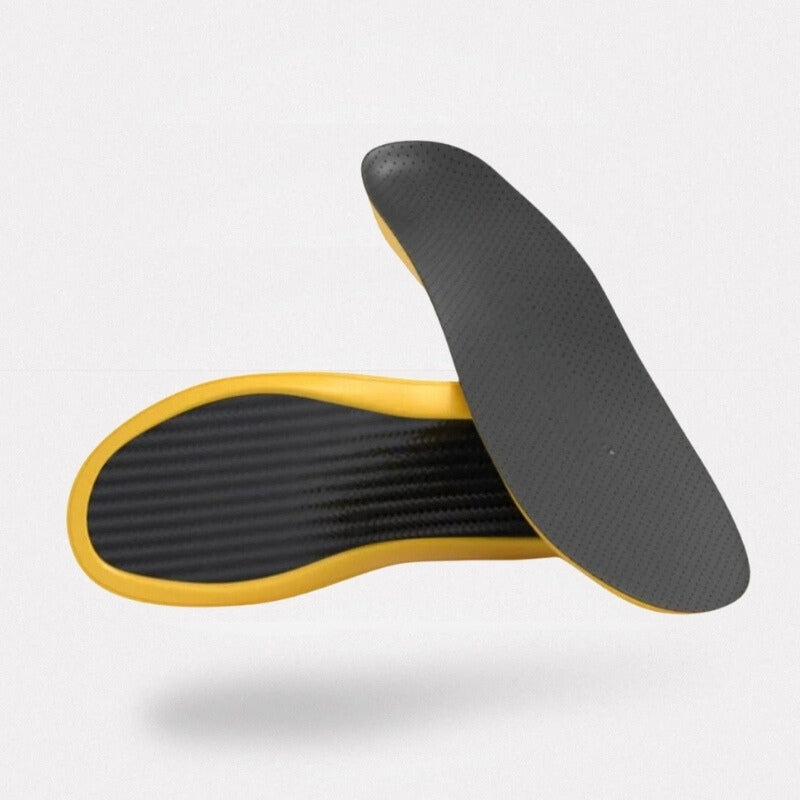
There's ongoing debate in podiatry about soft versus semi-rigid orthotic insoles for arthritis.
Soft insoles (pure foam or gel) are comfortable but can lack the structure needed to correct alignment. Over time, they compress and lose their cushioning properties. They're a reasonable entry point, especially for mild symptoms.
Semi-rigid insoles — with a firmer base layer topped by cushioning foam — offer more lasting support and better correction of gait mechanics. For moderate to severe arthritis, most podiatrists lean toward semi-rigid construction.
The Carbon Fiber Insoles Semello makes lean toward the firm, performance end — better for active users, runners, or people who need to be on their feet for long shifts. Less suited for purely home use, but strong for daily activity with arthritis.
What Won't Work And Why?
Generic foam insoles from a drugstore usually won't move the needle for arthritic feet. They're better than nothing — but just barely. They compress quickly, offer minimal arch structure, and don't address the alignment issues that drive joint strain.
Insoles that are too rigid can also backfire. A rock-hard insert with no cushioning layer transfers vibration rather than absorbing it. For inflamed joints, vibration is the enemy. The sweet spot is structured cushioning: enough firmness to support, enough softness to absorb.
How to Tell If Your Insoles Are Actually Working?
Give any new arthritis foot insole about two to three weeks of consistent use before judging. Signs it's working: pain is lower at the end of the day, morning stiffness eases faster, you're walking further before needing a break.
Signs it's not the right fit: new hotspots appear, arch pressure feels excessive, or your pain pattern shifts without improving. In that case, you need a different profile — more cushion, less rigidity, or a different arch height.
Most foot arthritis responds well to conservative management. The insole is one piece of it — alongside footwear choices, anti-inflammatory care, and when relevant, physical therapy. But it's the easiest piece to act on today.
Find the right insole for your foot type — browse the Semello collection