

Orthotic Insoles for High Arches: Why Standard Insoles Don't Work?
Most foot health advice is written for flat feet. Tips on arch support, insole recommendations, guidance from podiatrists — the vast majority of it focuses on overpronation, fallen arches, and the problems that come with feet that roll inward. High arches are mentioned in passing, if at all. But roughly 15% of the population has high arches. And for many of them, the pain is real, persistent, and made worse by the wrong kind of support. Here's what you actually need to know.
What High Arches Really Mean for Your Feet?

A high arch (medically known as pes cavus or cavus foot) is a foot structure where the arch stays significantly elevated — even when you're standing under your full body weight. Unlike a normal or low arch that spreads and flattens to absorb impact, a high arch remains rigid. That rigidity is the core of the problem.
When a normal foot strikes the ground, the arch flexes slightly, absorbing shock and distributing load across the whole foot. A high arch can't do this. Instead, the impact concentrates almost entirely on two points: the heel and the ball of the foot. The middle of the foot — the arch itself — barely contacts the ground at all.
The result is a chain of issues that most people don't immediately connect to their arch:
- Heel pain and heel fat pad syndrome: from excessive impact at every landing
- Metatarsalgia: pain and inflammation across the ball of the foot, where too much load concentrates
- Lateral foot pain: because high-arched feet tend to supinate (roll outward), stressing the outer edge
- Frequent ankle sprains: supination places the ankle in a vulnerable, inward-tilted position
- Plantar fasciitis: the fascia is under constant tension in a high-arched foot
- Claw toes and hammer toes: secondary deformities that develop over time from abnormal load distribution
- Knee, hip, and lower back pain: as the body compensates further up the chain
High-arched feet are also often rigid, meaning they don't adapt well to uneven surfaces. Every step is a small negotiation between a stiff foot structure and an unpredictable ground.
Want to go further? Read our guide on Best Orthotic Arch Support Insoles: Expert Picks for Pain Relief
Why Generic Insoles Make High Arches Worse?
This is the mistake almost everyone with high arches makes at some point.
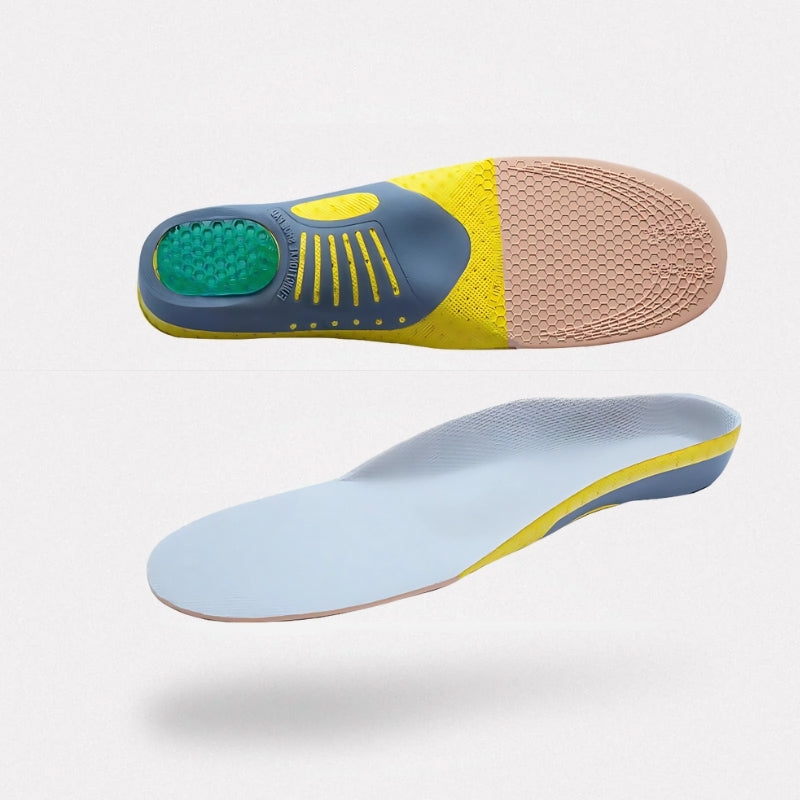
Standard over-the-counter insoles — the kind sold for "comfort" and "cushioning" — are typically designed around average or low arch profiles. They add padding at the heel and across the forefoot, but the arch zone is either flat or has a low-profile bump that completely fails to fill the gap beneath a high arch.
What happens when someone with high arches uses these? The arch hangs unsupported in mid-air. The same two pressure points — heel and ball — continue to absorb all the load. The insole adds a small amount of cushioning but doesn't change the underlying mechanics at all.
Worse: some cushioning-focused insoles actually increase the problem. By softening the surface under the heel and forefoot, they allow those areas to sink slightly deeper — increasing the effective height of the unsupported arch and making the load distribution even more uneven.
The right insole for high arches works completely differently. It doesn't just add padding. It fills the arch.
What Orthotic Insoles for High Arches Actually Need to Do?
According to experts, here’s what orthotic insoles do for high arches:
Fill and Support the Full Arch Height
The most important feature — and the one most generic insoles skip.
An orthotic insole for high arches needs to have a contoured arch that actually reaches up to meet the foot. This means a higher arch profile than standard insoles, shaped to match the elevated contour of a cavus foot. When the arch is properly supported from below, load is redistributed across the entire foot rather than concentrating at two extremes.
This isn't about pushing into a high arch aggressively. It's about filling the void so the foot has consistent contact and support across its full length.
Superior Shock Absorption

Because high-arched feet are rigid, they absorb almost none of the impact from each footfall themselves. That work falls entirely on the insole.
A good orthotic insole for high arches must compensate for this with meaningful cushioning — especially at the heel and metatarsal zone. Multi-layer construction (a supportive base with a softer top layer) is ideal: the base maintains structure, the top layer absorbs impact at each point of contact.
Deep Heel Cup
High-arched feet tend to supinate — the heel tilts inward and the foot rolls toward its outer edge. A deep heel cup cradles the heel in a more neutral position, counteracting this tendency and significantly reducing the risk of ankle instability and lateral foot pain.
This is one feature where high-arch insoles differ fundamentally from flat-feet insoles, which use heel cups primarily for pronation control. For high arches, the heel cup serves a stabilisation function.
Metatarsal Support
The ball of the foot takes disproportionate loading in high-arched feet. A metatarsal pad or raised metatarsal support within the insole helps spread pressure more evenly across the forefoot, reducing the hotspots that cause metatarsalgia and protecting the metatarsal bones from stress.
Not all insoles include this feature — but for anyone with persistent forefoot pain alongside high arches, it's worth prioritising.
Firm-but-Flexible Structure
Here's a nuance that matters: the arch support in an orthotic insole for high arches should be firm enough to maintain its shape and actually provide support through hours of wear — but not so rigid that it forces the foot into a fixed position.
High-arched feet benefit from support that allows some natural foot movement while preventing the extremes. Semi-rigid construction hits this balance better than either fully soft (which collapses) or fully rigid (which restricts).
Want to go further? Read our guide on Best Insoles for Flat Feet: Expert-Reviewed Guide to Find the Right Support
Choosing the Right Insole for Your Situation?
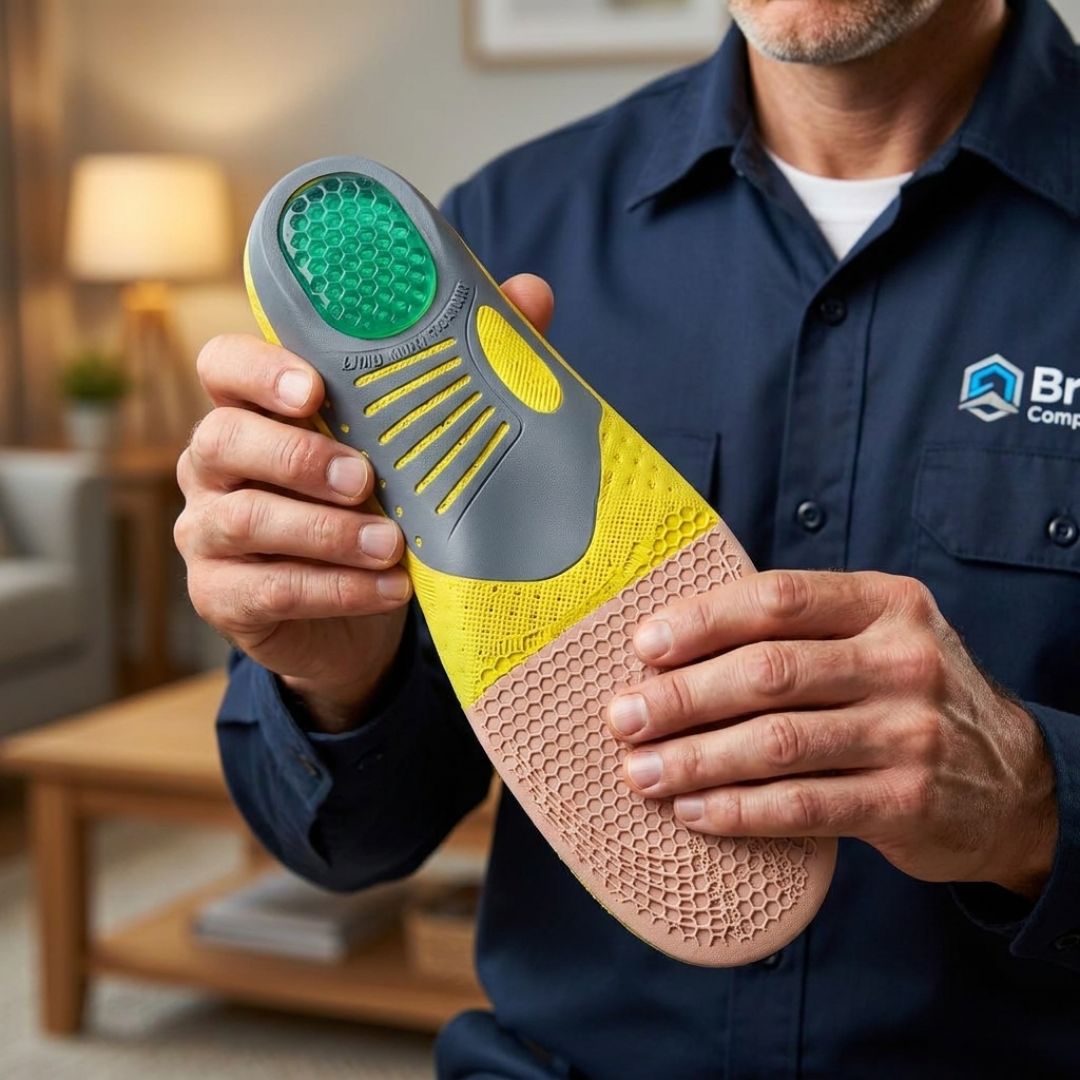
Not all high-arched feet are identical, and the right insole varies based on what you're experiencing and how you use your feet.
Everyday walking and work wear: Prioritise cushioning and arch fill. You're on your feet for extended periods and need sustained support that doesn't compress flat by midday.
Sports and higher-impact activity: Shock absorption becomes the priority alongside arch support. Look for multi-layer construction with specific heel and forefoot padding for impact management.
Chronic heel or metatarsal pain: Focus on targeted cushioning at the specific pain point, plus adequate arch fill to redistribute the load causing that pain.
Supination and ankle instability: Deep heel cup is non-negotiable. Combined with arch support, this is the most effective conservative intervention for high-arch supination.
Multiple pairs of shoes: A slim-profile insole that transfers easily between shoes is often more practical than a bulkier option. Consistency of use matters more than any single feature.
Semello's insole range is built with exactly these use cases in mind — structured orthotic support that addresses the specific mechanics of a high-arched foot, not just generic cushioning.
Explore Semello Orthotic Insoles & Inserts

How to Tell If Your Insoles Are Actually Working?
Many people try orthotic insoles for high arches, feel no improvement after a few days, and conclude they don't work. More often, the problem is one of three things:
- Wrong arch height. If the insole's arch profile doesn't actually reach your arch, you're getting cushioning but no structural support. The arch of the insole should make full contact with the arch of your foot.
- Not wearing them consistently enough. Orthotic insoles need to be in all your regularly worn footwear — not just one pair of shoes. If you wear unsupported shoes for part of the day, the benefit of the insoles is undone during those hours.
- Too short a break-in period. Structured orthotics change how your foot is loaded. The muscles and tendons that have adapted to your previous gait need time to adjust. A break-in period of 1–2 weeks, starting with 1–2 hours of wear per day and building up, is normal and important.
If all three conditions are met and you're still experiencing pain, the issue may be more complex and worth discussing with a podiatrist.
High Arches, Bunions, and the Full Picture
One thing worth knowing: high-arched feet are more prone to claw toes, hammer toes, and certain toe deformities than flat feet — because the way load concentrates in the forefoot puts ongoing stress on the toe joints.
If you have high arches and are noticing toe alignment issues alongside foot pain, addressing the mechanics of the whole foot — insoles for load distribution plus toe correctors for deformity management — tends to produce better outcomes than treating either in isolation.
Semello's range covers both: orthotic insoles for the mechanical foundation, and a bunion and toe corrector range for any secondary issues that develop alongside high-arch mechanics.
Explore the Semello bunion and toe corrector range

The Bottom Line
High arches don't get the attention flat feet do — but the pain they cause is just as real, and often harder to address because most generic products aren't designed for this foot type. The right orthotic insoles for high arches do four things: fill the arch properly, absorb shock at the heel and forefoot, stabilise the heel to prevent supination, and distribute load more evenly across the whole foot.
Everything else is comfort. And comfort, without the right structure underneath, doesn't last past noon. If your feet have been telling you something for a while — through heel pain, ball-of-foot soreness, ankle instability, or just that exhausted feeling by the end of the day — it may be time to give them the specific kind of support they've been missing.
Find the right Semello insoles for your feet
FAQ — High Arches & Bone Spurs
Do orthotics work for high arches?
Yes — and they're one of the most effective interventions for high-arched feet. A high arch (cavus foot) concentrates bodyweight on the heel and ball of the foot instead of distributing it evenly, leading to chronic pain, stress fractures, and plantar fasciitis. Orthotics designed for high arches fill the gap under the arch, redistribute load across the entire foot, and reduce the impact on pressure points with every step.
What type of insole is best for high arches?
Look for a rigid or semi-rigid insole with a pronounced, contoured arch fill — not a flat cushioned pad, which does nothing to support an elevated arch. The insole should make full contact with your arch without requiring you to "break it in." A deep heel cup adds stability. Avoid overly soft insoles: they compress under bodyweight and lose their corrective shape within weeks, leaving you with no real support.
Do insoles help with bone spurs?
They don't remove the spur, but they significantly reduce the pain it causes. Heel spurs form where the plantar fascia repeatedly pulls on the heel bone — the spur itself is often painless, but the surrounding inflammation isn't. A well-designed insole with targeted heel cushioning absorbs impact before it reaches the spur, while arch support reduces the fascial tension that caused the spur to develop in the first place. Semello's Heel Spur Insoles are built specifically for this.