

Braces for Drop Foot Explained: Types, Benefits, and How to Choose
The foot that won't lift. The toe that drags. The constant anxiety before every step. Drop foot is one of those conditions that changes everything about how you move — and for many people, the right brace for drop foot is what stands between them and a fall. But not all braces are built the same, and choosing the wrong one can leave you worse off than before.
Here's what you actually need to know.
What Is Drop Foot?

Drop foot — also written as foot drop — is not a disease. It's a symptom.
Specifically, it's the inability to lift the front part of the foot during walking. The dorsiflexor muscles, which normally pull the toes upward during each step, are weakened or no longer working properly. The result: the toes drag on the ground instead of clearing it, which disrupts your gait and dramatically increases the risk of tripping.
It can affect one foot or both. It can come on suddenly or develop gradually. And it can range from a minor inconvenience to a condition that severely limits independence. The underlying causes vary widely — which matters a lot when choosing how to treat it. More on that in a moment.
What Causes Drop Foot?
Understanding the cause shapes everything about treatment. The most common culprits:
- Peroneal nerve injury: The peroneal nerve runs along the outer side of the knee and controls the muscles that lift the foot. It's vulnerable to compression (crossing your legs habitually, prolonged kneeling, or a cast that's too tight) and to direct trauma. This is the most frequent cause of drop foot.
- Neurological conditions: Stroke, multiple sclerosis, and motor neurone disease can all affect the nerve signals that control dorsiflexion. In these cases, drop foot is often one symptom among several.
- Spinal cord problems: Herniated discs or spinal stenosis can compress the nerve roots that feed the lower leg, leading to weakness in the foot.
- Muscle or tendon damage: Less common, but direct injury to the lower leg muscles can impair their ability to lift the foot.
Why does this matter for choosing a drop foot brace? Because the brace that works best for someone with a compressed peroneal nerve from a cast isn't necessarily the right one for someone recovering from a stroke. The severity, the underlying cause, and the prognosis all influence the decision.
Check out our article on: Best Insoles for Heel Pain | Expert Guide & Top Picks
How Do Braces for Drop Foot Work?
The core function is simple: hold the foot in a position that allows normal gait.
During walking, the foot needs to clear the ground during the swing phase — that moment when your leg swings forward before the next heel strike. Without dorsiflexion, the toes drag instead of lifting. A drop foot brace compensates by holding the ankle at roughly 90 degrees, so the foot is in a neutral position throughout the stride.
Depending on the brace type, it may also:
- Stabilize the ankle laterally, reducing the risk of rolling
- Store and release energy during the gait cycle, improving efficiency
- Allow some controlled movement while still providing lift
The best braces for drop foot don't just prevent dragging — they promote a more natural walking pattern, reducing the compensatory movements (like hip hiking or steppage gait) that people develop to cope, and which cause secondary strain over time.
The Main Types of Drop Foot Braces

This is where most people get confused. There are several distinct categories, each with different trade-offs.
Ankle-Foot Orthoses (AFOs)
AFOs are the most commonly prescribed braces for drop foot. They extend from just below the knee to the foot, holding the ankle in dorsiflexion. They come in two main forms:
Rigid AFOs provide maximum support and control. They're typically made from polypropylene and fix the ankle in a set position. Best for severe weakness or high tone. The trade-off: limited sensory feedback through the foot, reduced ankle mobility, and they require specific footwear.
Dynamic/articulated AFOs allow some ankle movement while still controlling drop. A hinge mechanism lets the ankle plantarflex (push down) freely, while a spring or resistance element assists dorsiflexion during swing. More natural gait, but more complex and typically more expensive.
Leaf Spring AFOs
A subset of dynamic AFOs, leaf spring designs use a thin flexible blade — often carbon fiber — that stores energy during heel strike and releases it to assist toe clearance. They're lightweight, low-profile, and can fit inside many shoes. A strong option for mild to moderate drop foot with minimal spasticity.
Soft AFOs and Dorsiflexion Assist Straps
For mild drop foot, soft fabric braces with a strap system can assist lift without the bulk of a rigid AFO. These wrap around the lower leg and attach to the shoelaces, pulling the toe up during swing. They're discreet and easy to put on, but offer less control than hard AFOs.
Functional Electrical Stimulation (FES) Devices
Not a brace in the traditional sense, but worth mentioning. FES devices use electrical impulses to stimulate the peroneal nerve and trigger dorsiflexion automatically during walking. They're typically used in stroke rehabilitation and require clinical assessment to determine suitability.
Check out our article on: Orthotic Insoles for Overpronation: Best Support for Alignment
How to Choose the Right Drop Foot Brace?
There's no universal answer — but there are clear criteria.
Severity of weakness: Mild weakness with some residual muscle function suits a dynamic or leaf spring AFO, or a soft dorsiflexion strap. Severe paralysis or high spasticity usually requires a rigid AFO or clinical orthosis.
Underlying cause and prognosis: If the drop foot is likely temporary (post-surgical nerve compression, for example), a less invasive option may be appropriate while the nerve recovers. Permanent conditions typically warrant a more robust long-term solution.
Lifestyle and activity level: Someone who walks long distances or works on their feet needs a brace that performs under sustained use. Someone who needs support primarily around the home has different requirements.
Footwear compatibility: Rigid AFOs require shoes with removable insoles and a wide toe box. If shoe choice matters to you, a low-profile leaf spring or soft AFO gives more flexibility.
Skin sensitivity: People with neuropathy or compromised circulation need to pay close attention to fit and padding. Pressure sores from a poorly fitted brace are a serious risk.
One thing that applies universally: if you haven't already seen a physiotherapist or orthotist, do so before purchasing. A drop foot brace fitted without proper assessment often creates new problems while solving the original one. The fit matters as much as the type.
Living With Drop Foot: Beyond the Brace
A brace manages the symptoms. It doesn't address the underlying cause. Depending on what's driving the drop foot, physiotherapy is often the most important parallel treatment. Exercises that strengthen the dorsiflexors, improve ankle mobility, and retrain gait patterns can lead to meaningful recovery — especially when the nerve damage is partial rather than complete.
Gait training, balance work, and even swimming can all support rehabilitation. And for some people, over months of consistent rehab, the brace becomes less necessary as function gradually returns.
That's the goal: use the brace to stay mobile and safe while the underlying condition is treated. Not to depend on it indefinitely.
There's also the question of everything else happening with your feet. Drop foot often comes alongside other foot and toe issues — hammer toes, claw toes, and forefoot misalignment are common in people who have altered gait for months or years. The way you compensate for drop foot changes how your toes load with every step, and that shows up over time.
Check out our article on: Diabetic Shoes: What They Are and How to Choose the Right Pair
Supporting the Whole Foot — Not Just the Ankle

This is where foot care extends beyond the brace itself. People managing drop foot often develop secondary toe deformities from altered weight distribution and compensatory gait. Hammer toes, claw toes, and lateral pressure on the pinky toe are frequent companions to long-term gait changes.
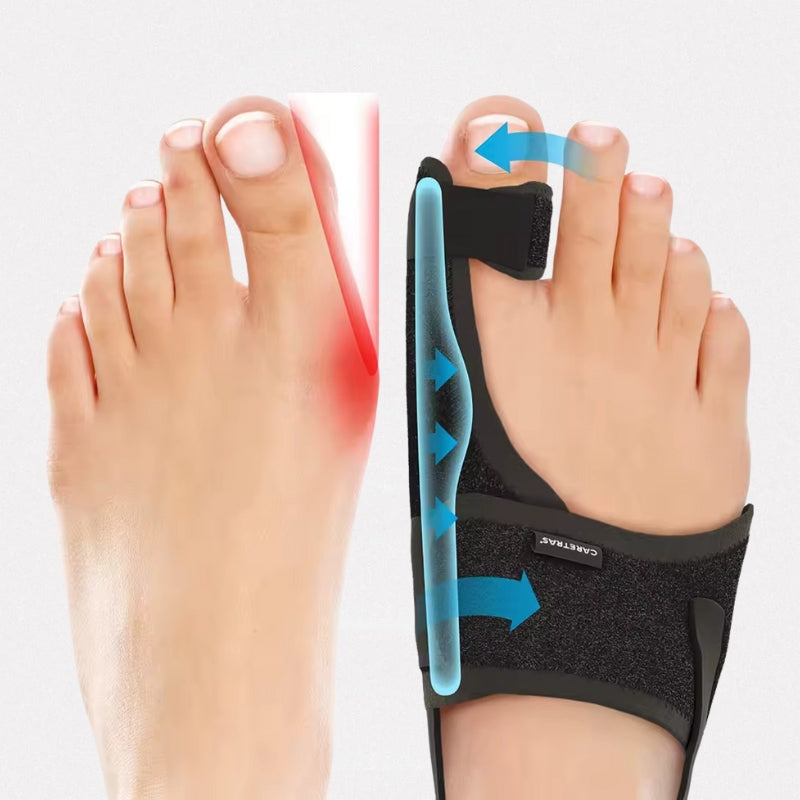
Toe support braces, splints, and correctors work alongside AFOs to address these secondary issues — keeping the toes aligned, reducing friction and pressure, and preventing deformities from worsening while mobility is already compromised.
At Semello, we develop orthopedic solutions in collaboration with podiatrists, with a focus on the kind of toe and forefoot issues that often develop in the context of altered gait and foot mechanics. Whether it's the bunion Corrector Brace, the Hammer Toe Support Brace, or the Slim Bunion Splint, the range is designed to support proper toe alignment — day and night.
If you're managing drop foot and noticing changes in your toes or forefoot, addressing them early matters. Deformities are easier to correct — or at least slow down — before they become structural.
Explore Semello Toe & Forefoot Braces: semello-shop.com/collections/bunion-relief-toe-corrector
The Bottom Line
Braces for drop foot are not one-size-fits-all. The right choice depends on the severity of your condition, its underlying cause, your lifestyle, and your footwear needs. Start with a proper assessment. Choose a brace that matches both your level of weakness and your daily life. Use it consistently, and pair it with physiotherapy if recovery is possible.
And don't neglect the rest of the foot. Drop foot changes how every part of your foot loads — and your toes pay the price over time.