

Orthotic Insoles for Running: Who Actually Needs Them and What to Look For
Not every runner needs orthotic insoles. That's the honest starting point — and it's one that most insole marketing skips entirely. But for runners who do need them, the difference is real. Running is a high-load, high-repetition activity. A small biomechanical problem that causes mild discomfort during a walk can become a serious overuse injury at 30 miles a week. Getting the mechanics right matters more in running than in almost any other daily activity — and the wrong insole choice can make things worse just as easily as the right one improves them.
What Running Does to Your Feet?
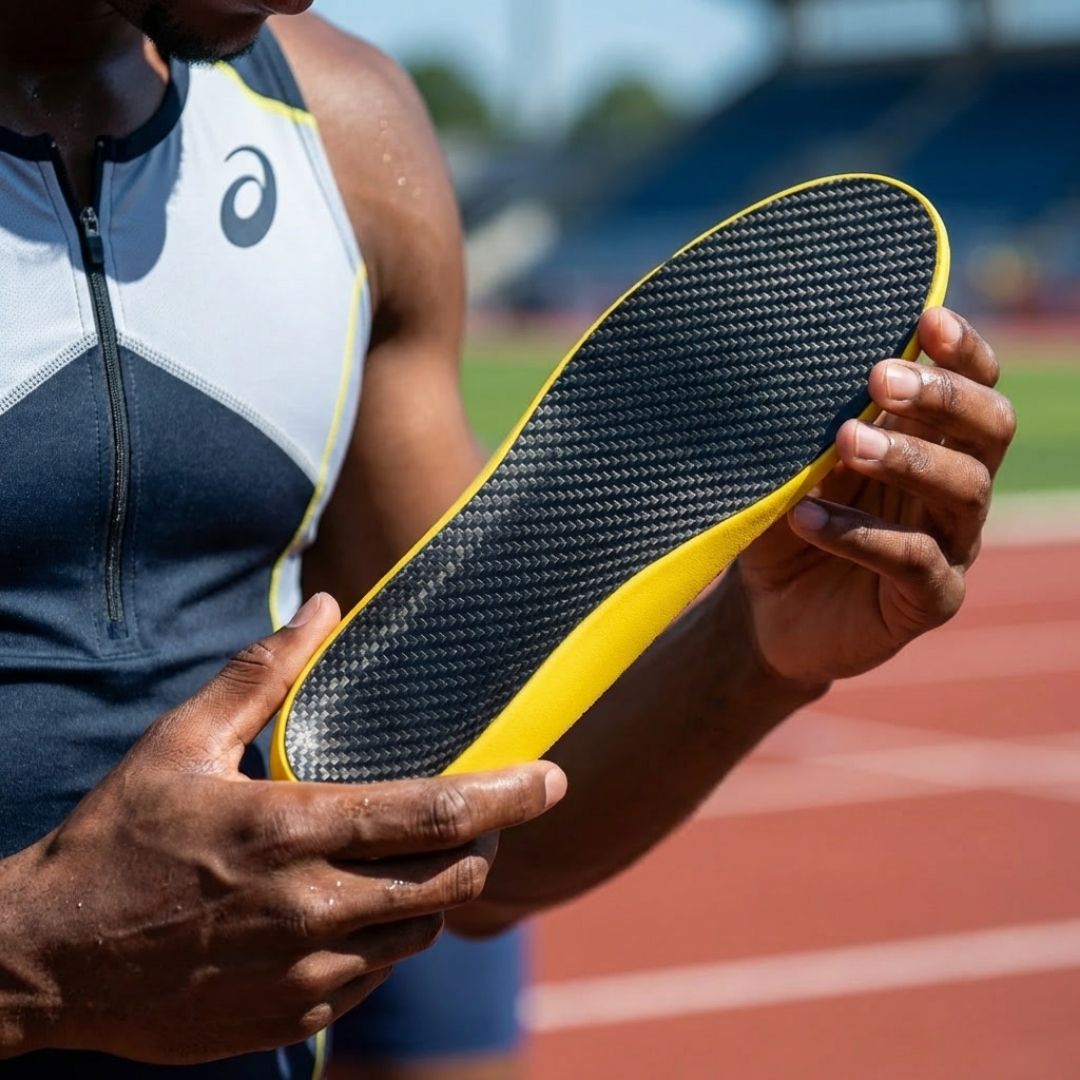
Each foot strike during a run generates impact forces of two to three times your body weight. Over the course of a 5K, that's roughly 3,000 foot strikes per foot. Over a half marathon, closer to 10,000.
That kind of load amplifies whatever inefficiency exists in your foot mechanics. Mild overpronation that barely registers during walking becomes a significant inward rotation force at every heel strike when running. A slight arch collapse under walking load turns into full forefoot collapse at running pace. A 50% of recreational runners will sustain an injury that disrupts their training within a single year — and poor load distribution through the foot is one of the consistent contributing factors across the most common running injuries: plantar fasciitis, shin splints, metatarsalgia, and stress fractures.
Orthotic insoles work by changing the mechanical environment the foot operates in at each of those thousands of foot strikes. They don't fix the anatomy — they change the forces.
Orthotic Insoles for Running: Who Actually Benefits?

Running orthotics are not universal equipment. Runners with healthy mechanics, no pain, and no injury history may get nothing from them. For some, the wrong insole can introduce new problems. The runners who benefit most tend to fall into recognizable categories:
Flat feet and overpronators
When the arch collapses, the foot rolls inward on each stride. That inward motion transfers load up the kinetic chain — excess stress on the medial knee, the tibialis posterior tendon, the plantar fascia. Recurring shin splints, medial knee pain, and plantar fasciitis in flat-footed runners are often downstream symptoms of this. A structured insole with firm arch support and a deep heel cup interrupts that pattern by keeping the foot in a more neutral position through the gait cycle.
Discover the best insoles here: Orthotic Insoles for Overpronation: Best Support for Alignment
High arches
High arches create the opposite problem to flat feet: too little contact area, so load concentrates at the heel and the ball of the foot. Shock absorption is poor, which shows up as heel pain, stress fractures in the metatarsals, and forefoot fatigue on longer runs. Cushioned insoles with shock-absorbing materials address this directly.
Plantar fasciitis
The most common running injury, affecting roughly 1 in 10 people at some point. The plantar fascia — the thick band of tissue running along the bottom of the foot — becomes inflamed from repetitive overload. The most effective way to relieve plantar fasciitis pain, and prevent recurrence, is to keep arches from flattening by adding firm arch support to footwear. An insole that supports the arch reduces the strain placed on the fascia with each step.
Check out the best insoles here: Best Orthotic Arch Support Insoles: Expert Picks for Pain Relief
Heel spur pain
Heel spurs often develop alongside plantar fasciitis — calcification on the heel bone where the fascia attaches. Insoles with a structured heel cup and targeted heel cushioning reduce direct impact on the affected area.
Achilles tendon issues
Gel heel lifts reduce the angle of stretch on the Achilles with each stride, taking tension off an already irritated tendon. For runners managing Achilles tendinopathy, this is a simple mechanical adjustment worth making.
Find the best insoles here: Best Morton’s Neuroma Orthotic Insoles: Top 7 Expert Picks & Guide
Runners returning from injury
During recovery, the foot often needs mechanical support it was managing on its own before. Orthotic insoles give the healing tissue more favorable loading conditions.
Runners with none of these issues — good arch structure, neutral gait, no injury pattern — typically don't need additional support. If normal running feels comfortable and injuries are not recurring, the shoe's existing support is probably doing the job.
What the Evidence Actually Says?
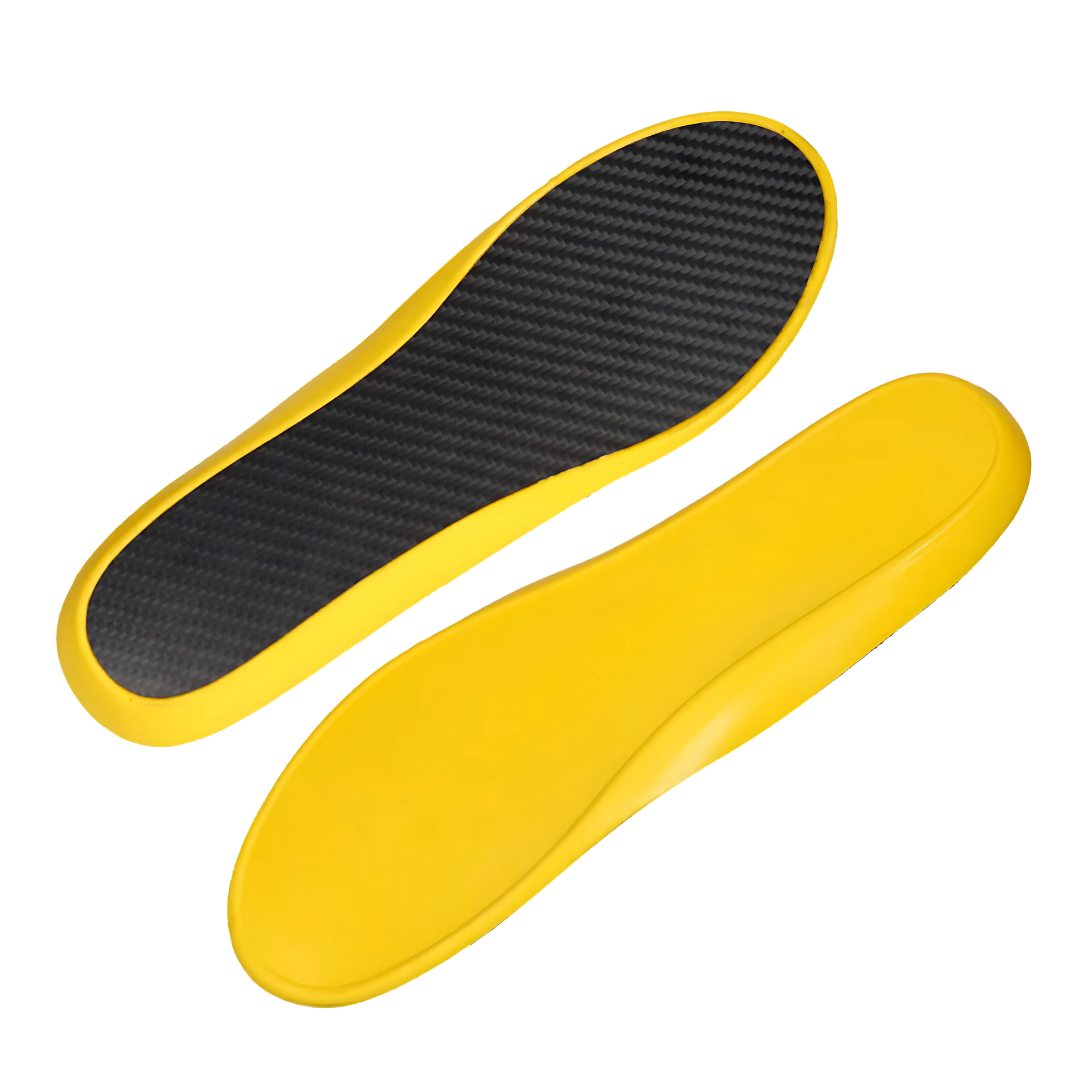
Two systematic reviews have found low to moderate quality evidence supporting the use of foot orthoses in preventing overuse running injuries. A major meta-analysis of 11 clinical trials found foot orthoses effective for preventing overall injuries and stress fractures in athletic populations.
The injury-prevention data is more consistent than the performance data. Some studies suggest orthotics reduce energy expenditure in runners with specific biomechanical imbalances. Others find no meaningful performance benefit for the average runner. What the research consistently supports is this: in runners with identifiable mechanical problems — flat feet, overpronation, plantar fasciitis — orthotic insoles reduce pain and injury risk. In runners without those problems, the effect is unclear and may be neutral.
This matters for how you use this information. Running orthotics are a targeted tool, not a general upgrade.
Carbon Fiber vs. Cushioned: The Biggest Materials Decision
This choice matters more for runners than it does for everyday wear, because running puts structural demands on an insole that walking doesn't.
Carbon fiber insoles are rigid, lightweight, and durable. The stiffness does two things: it reduces toe bending (which aggravates injuries like plantar plate sprains, sesamoiditis, and morton's neuroma), and it helps with energy return on push-off. Running requires a lot of bending of the toes, and a rigid plate that runs the full length of the shoe reduces that bending motion — both protecting vulnerable structures and improving propulsion efficiency. Carbon fiber insoles that flex can buckle under the forces common in running, defeating the purpose — so the rigidity isn't a drawback, it's the point.
For serious runners, high-mileage training, or anyone managing toe-related injuries, carbon fiber is the right material. It outlasts foam or gel by years and maintains its support characteristics under sustained load.
Cushioned and semi-rigid insoles suit a different use case: managing impact-related pain, plantar fasciitis, heel spur discomfort, and Achilles irritation. The goal here is load absorption, not energy return. These pair a structured arch — firm enough to actually hold its shape during a run — with enough cushioning at the heel and forefoot to take the edge off high-impact repetition. Soft gel alone isn't enough; it compresses fast and provides no real structural support after the first hour.
Semello's Running Insole Range — Matched by Injury Type
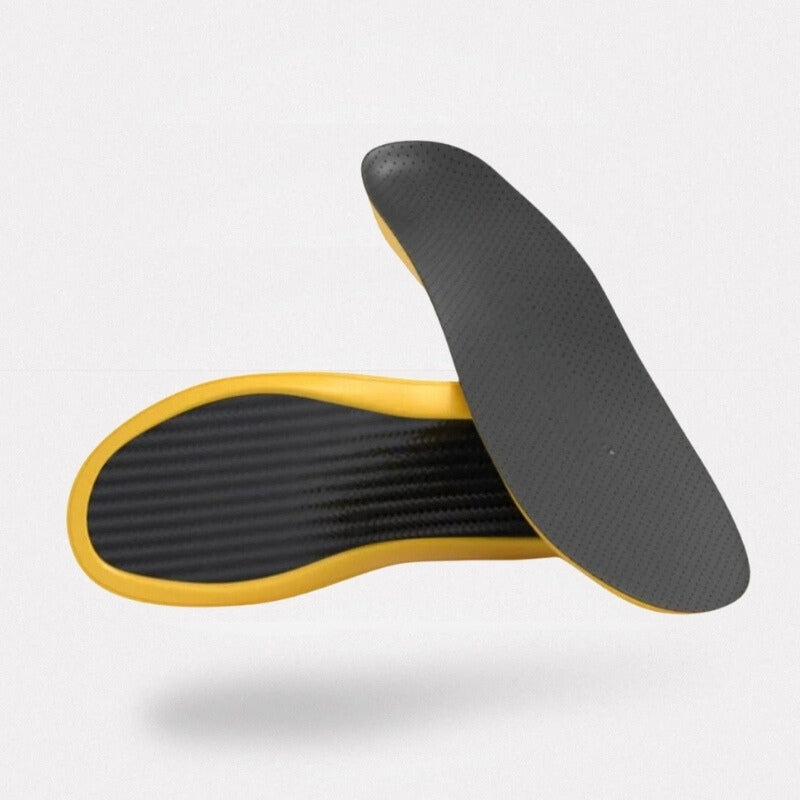
The Semello orthotic insole range covers both ends of the spectrum:
1. For performance, high mileage, and toe-related injuries
The Carbon Fiber Insoles — Arch Support for Running are the flagship option for serious runners. The rigid carbon plate provides structural arch support without bulk, delivers energy return on push-off, and protects against the toe-bending injuries that accumulate over long training blocks. They're built to last well beyond a season without losing their structural integrity — unlike foam-based insoles that soften and lose shape within months of regular running use.
2. For plantar fasciitis, arch pain, and overpronation
The Insoles for Plantar Fasciitis — Arch Support & Heel Cushion are the go-to for the most common running injury. A semi-rigid arch structure keeps the fascia from overloading on each stride, while the heel cushion absorbs the impact that would otherwise fire directly into inflamed tissue. Consistent use — not just during runs but throughout the day — is what makes the difference with plantar fasciitis.
3. For heel spur pain and rearfoot impact
The Heel Spur Insoles — Arch Support & Heel Cushion pair a deep heel cup with targeted cushioning at the calcaneal contact zone — where the spur and the ground meet with every foot strike. Worth using in both running shoes and everyday footwear, since the tendon and fascia don't stop experiencing load the moment you're off the track.
4. For Achilles tendinopathy and heel-to-toe transition pain
The Gel Heel Lifts — Heel Pain & Achilles Comfort Pads reduce the degree of stretch placed on the Achilles with each stride by elevating the heel slightly. A simple mechanical adjustment — and for runners managing tendinopathy during a training block, it's often the difference between continuing to run and stopping entirely.
5. For shock absorption without a full insole
The Gel Heel Cups — Shock Absorbing Heel Pads are the low-profile option when the running shoe already fits well but needs more impact protection at the heel. These don't replace a full insole for biomechanical issues, but for pure cushioning in a shoe that won't accommodate a full-length insert, they work.
Browse the full Semello running insole range.

What Doesn't Matter as Much as Marketing Suggests
A few things that get oversold:
Thickness. Thicker isn't better. Excess bulk raises the heel position in the shoe, alters the heel-to-toe drop, and can change the fit enough to cause blisters or new pressure points. A thin, rigid carbon fiber insole often outperforms a thick foam one for running.
Gel everywhere. Gel feels good in the shop. Under running conditions, soft gel compresses and loses its structure within a few kilometers. For everyday walking this matters less; for running, structure is more important than initial softness.
Custom vs. OTC for most runners. Custom orthotics, cast from your foot by a podiatrist, are the most precise option. They're also $300–$600 and require a clinic visit. For most recreational runners, a high-quality OTC insole that targets their specific problem — arch collapse, heel impact, forefoot pain — works well enough that the upgrade to custom isn't necessary unless OTC options have been tried and haven't resolved the issue.
When to Stop Self-Managing
Running through pain with the right insole is different from running through structural damage. If pain is increasing rather than stable, appearing earlier in runs over time, or present even at rest or first thing in the morning, that's a signal to see a podiatrist rather than try another insole.
A podiatrist can do a gait analysis, assess your specific foot mechanics, and tell you whether an OTC insole is appropriate or whether a custom device or a period of rest is what's actually needed. Getting that assessment before the injury compounds is faster than managing a full-blown overuse injury on the other side of it.
Putting It Together
Orthotic insoles for running earn their place when there's an identifiable mechanical problem behind the pain — flat feet, overpronation, plantar fasciitis, heel spurs, Achilles irritation. For runners without those issues, the benefit is genuinely unclear and probably minimal.
If you're dealing with any of the above: match the insole to the actual problem, prioritize structure over cushioning for high mileage, and consider carbon fiber if you're running distance and want something that holds up through a full training season. If you're not sure which problem you're managing, one session with a podiatrist is worth more than three insole purchases made without that information.
Find the right insole for your training: semello-shop.com/collections/insoles-inserts